
The turn that cannot be answered
Gomoku double threats: why one stone can end a game before five
The most useful Gomoku skill is not counting to five. It is noticing when one empty point can create two problems on the next move. A double threat leaves the defender with one turn and two required answers. The final five is a formality; the fork is the move that won.
Read shapes by their open ends
A row is not dangerous merely because it is long. Its open ends decide how fast it can grow. A closed three has one obvious continuation. An open three has two. If it becomes an open four, the defender cannot cover both winning points with a single stone.
That is why experienced players inspect the spaces around a row before they count its stones. An open shape asks a question about the next turn. A closed shape often gives the defender time to make a plan of their own.
The fork is built from quiet stones
Double threats rarely appear from nowhere. Two loose pairs slowly approach an empty crossing. When the attacker takes that point, one move creates two open threes, a four and a three, or two immediate winning points.
By the time you see two loud threes, you may already be late. The earlier warning is simpler: two of your opponent’s groups share a useful empty intersection. If you can take that point before it becomes forcing, you often prevent the whole sequence.
Defence can be an attack, but only if it really forces
Sometimes you cannot quietly block a fork because your opponent will make a four first. A four of your own can buy a turn: it must be answered before the other player continues their plan. This works only when your threat is genuinely forcing.
Do not call every extension a counter-attack. If your opponent can ignore it and still make an open four, you have not changed the problem. You have simply spent a move arriving at the same loss later.
On the board
Two positions worth recognizing
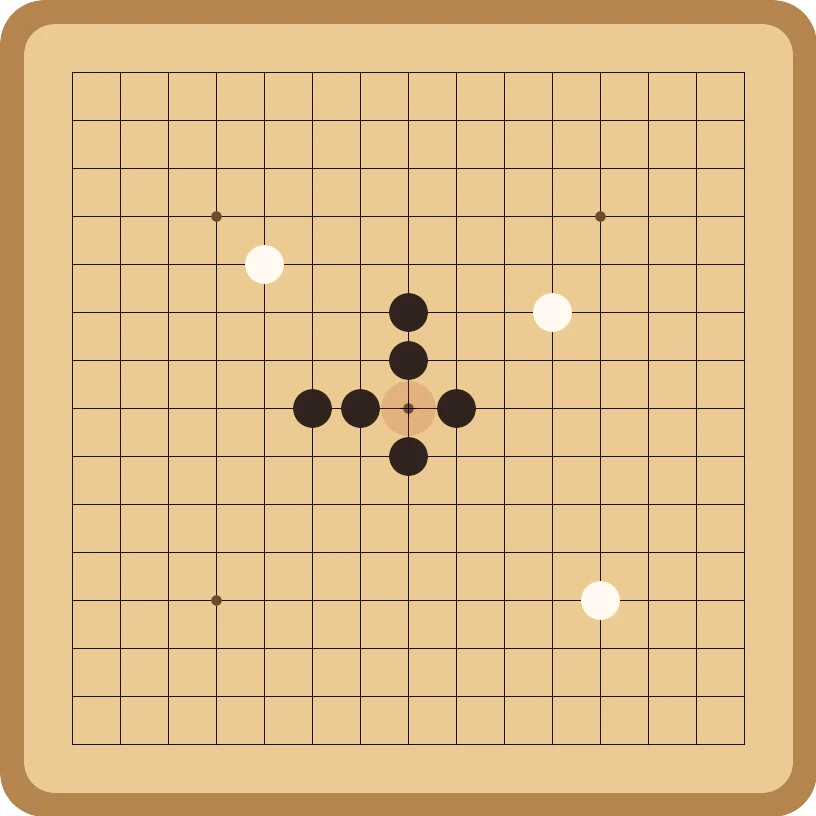
Two open threes
Black takes a crossing point shared by a horizontal pair and a vertical pair. White can block one direction. Black uses the other direction to make an open four.
A four-three
Black plays one stone that makes a four and an open three. White must cover the four now, handing black the time to turn the remaining three into the next forcing shape.
Do not get caught here
Three checks before you commit a stone
- A closed three is not the same thing as an open three; count the empty ends before you panic.
- If your opponent can make five immediately, your planned fork does not matter unless your move makes five first.
- A double threat is only decisive when the two replies are genuinely different. Check whether one defensive point happens to stop both lines.
Questions players actually ask
Gomoku FAQ
What is a double threat in Gomoku?
It is a move that creates two threats the opponent cannot both answer in one turn, such as two open threes or a four and an open three.
Why is an open four usually a win?
An open four has two empty ends that each complete five. The defender can place only one stone, leaving the other winning point available.
How do I defend against a double threat?
Look one move earlier for the crossing point shared by two loose groups. If the fork has already landed, search for an immediate winning or forcing threat of your own; otherwise the position may be lost.
Can I learn double threats without memorizing coordinates?
Yes. Train your eye to notice open ends and shared empty intersections. The patterns matter more than the letters and numbers around a board.