
The first few stones
Gomoku openings: play for a second future, not a neat first row
A good opening rarely looks dramatic. It is usually a stone near the middle that keeps two directions available while making one obvious reply less useful. The point is not to memorize a sacred sequence. It is to avoid spending your first six moves building a row that has only one future.
Why the centre is useful without being magic
A centre stone has room in four directions. An edge stone has fewer useful continuations because the board closes one or more ends for you. That is why central openings are common: they preserve options while the position is still empty.
Central does not mean every move belongs on the exact middle point. One step off-centre is often where two possible lines can share a future intersection. Look for room, not a ceremonial square.
The row that looks good can be the easiest to stop
Two adjacent stones invite a third. Extending them again may be right, but it also tells your opponent precisely where to defend. If the other end is the only continuation, one block can turn your tidy plan into dead weight.
A stronger early move often looks less satisfying. It may sit one point away from your pair, keep a diagonal alive, and create no immediate threat at all. Its value appears when the obvious block no longer stops everything.
Defend the empty intersection, not just the latest stone
After each opponent move, look for two of their loose groups that could meet at one empty point. That point may be more urgent than the stone they just placed. Taking it can blunt a future fork while also starting something of your own.
This is the opening habit that changes casual games most: scan the board for crossings before extending your nearest pair. You will still make rows. You will simply stop making rows that announce their only plan.
On the board
Two positions worth recognizing
A patient third stone
Black has a pair near the middle. Rather than extend it into a visible three, black takes a nearby point that also lines up diagonally. White can block the obvious row later, but not both ideas with the same stone.
A useful defensive move
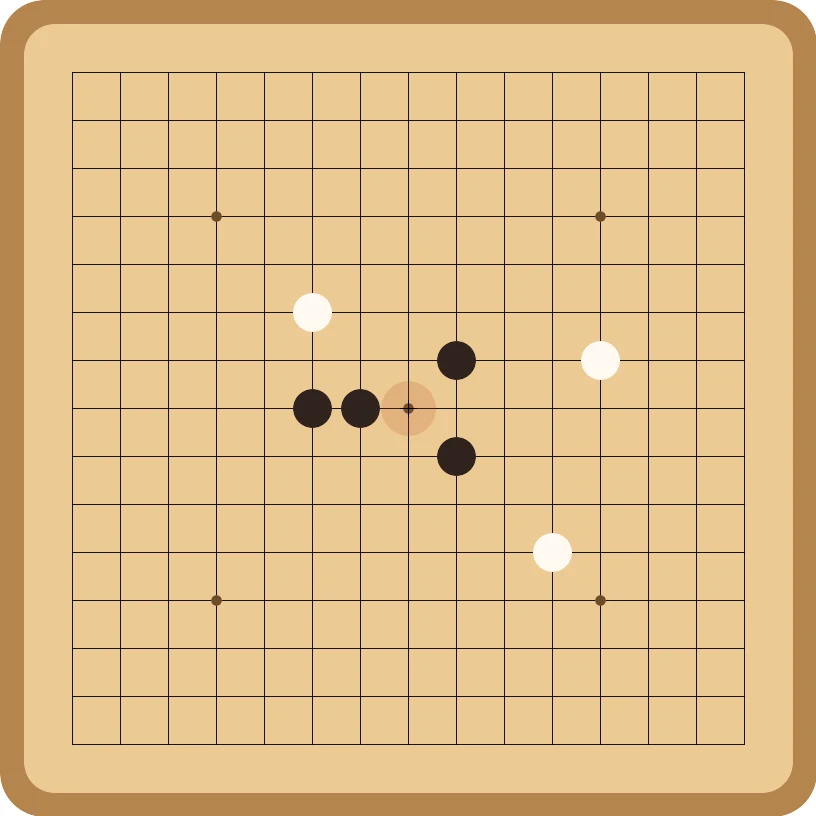
White sees two black pairs on different lines approaching the same empty point. Taking that point does more than block a row: it removes the place where black hoped to create a double threat.
Do not get caught here
Three checks before you commit a stone
- Playing near the centre does not excuse ignoring an immediate four or a forced block.
- A symmetrical-looking opening is not automatically balanced; black still has the first move.
- Do not copy a diagram move-for-move when the opponent’s stones are in different places. Copy the reason for the move instead.
Questions players actually ask
Gomoku FAQ
What is the best first move in Gomoku?
For casual freestyle play, a central opening is practical because it leaves room in every direction. There is no single sequence that solves every position after that.
Should I always extend two stones into three?
No. First check whether that extension leaves you with only one useful end. A nearby point that keeps a second line alive can be stronger.
Why are edge openings harder to use?
The edge removes possible continuations. A stone near the middle can still participate in more horizontal, vertical, and diagonal lines.
How can I practice Gomoku openings against the AI?
Use Medium and spend the first ten moves naming two directions for every stone you consider. Replay afterward and look for the crossing you did not notice.