
The board’s agreement
Gomoku rules for the game you are actually about to play
You do not need a tournament rulebook to start a good Gomoku game. You do need both players to mean the same thing by “five.” This board uses freestyle rules: black starts, each turn adds one stone to an empty intersection, and the first unbroken line of five or more wins.
The first minute of a game
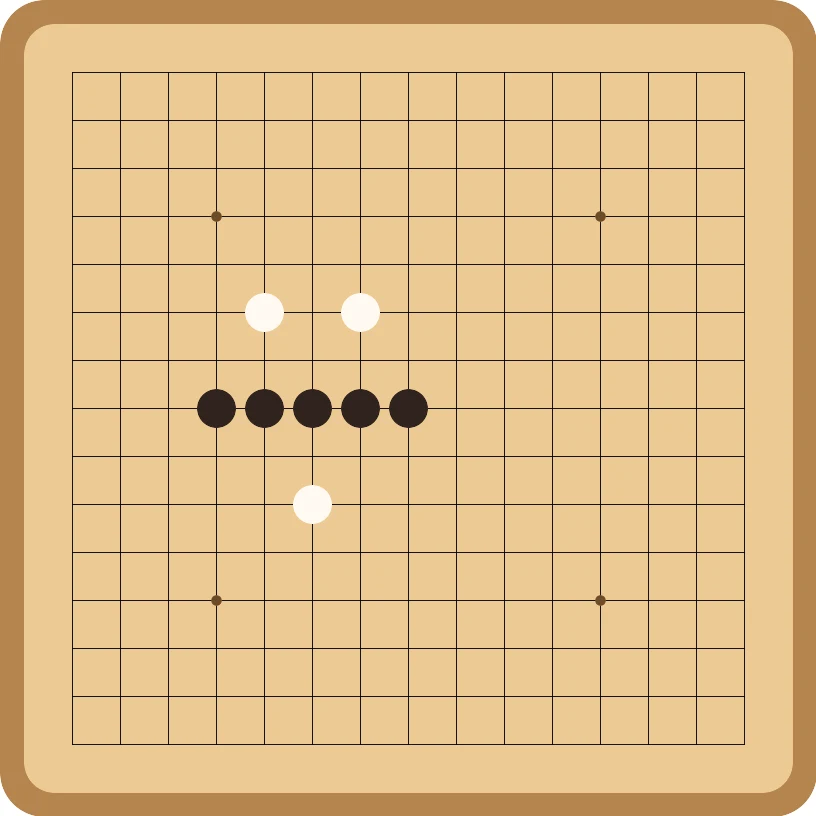
Black plays first. Then black and white alternate, placing one stone on any empty intersection. Stones do not move, jump, capture, or disappear. A horizontal, vertical, or diagonal line of five consecutive stones wins immediately.
The board is 15×15. That sounds like a detail, but it changes how early moves feel. There is enough room for a stone to be part of several plans, so a row that looks harmless can become important when another line approaches it.
What “freestyle” changes
Freestyle means a line of six or more also wins. It also means black may make double-threes and double-fours. Those shapes are banned or handled differently in Renju, a competitive cousin designed to reduce black’s first-move advantage.
That difference matters only when players bring different expectations. If you learned from a Renju app, do not assume its forbidden-move warnings apply here. If you are playing casually, freestyle keeps the question simple: can either player connect five first?
The rule that causes most friendly arguments
An overline is six or more connected stones. Here, it wins. On some boards it does not; on others it is an illegal black move. Neither side is “cheating” when this disagreement appears — they may simply be playing different rulesets.
Settle that question before the first stone, especially in local play. The same applies to undo. The board offers it as a learning tool, but two people should decide whether an undo is a takeback, a reset, or unavailable once the game has started.
On the board
Two positions worth recognizing
A diagonal counts
Four black stones running down-right are not a near miss. The fifth stone can be placed at either open end, and it wins just as a horizontal five would.
Six is not too many here
If a stone joins six connected black stones, black wins immediately on this freestyle board. Do not keep playing to see whether the row becomes exactly five.
Do not get caught here
Three checks before you commit a stone
- Stones are placed on intersections, not inside the squares between grid lines.
- A line must be consecutive. Four stones with an opponent’s stone or an empty gap between them are not four in a row.
- This how-to board is for one device. Two browsers need the Online table, where undo is off and the room confirms each stone.
Questions players actually ask
Gomoku FAQ
Does black always go first in Gomoku?
Yes. Black opens every game on this board, then white and black alternate one stone per turn.
Does a line of six stones win in this game?
Yes. This board uses freestyle Gomoku, so five or more consecutive stones of one colour win.
Are double-threes forbidden on this board?
No. Double-threes and double-fours are legal here. Those restrictions belong to particular Renju rulesets, not this freestyle board.
Can two people play on the same device?
Yes. Choose Local, then pass the device after each move. The rules and board are the same; only the person choosing the next stone changes.