
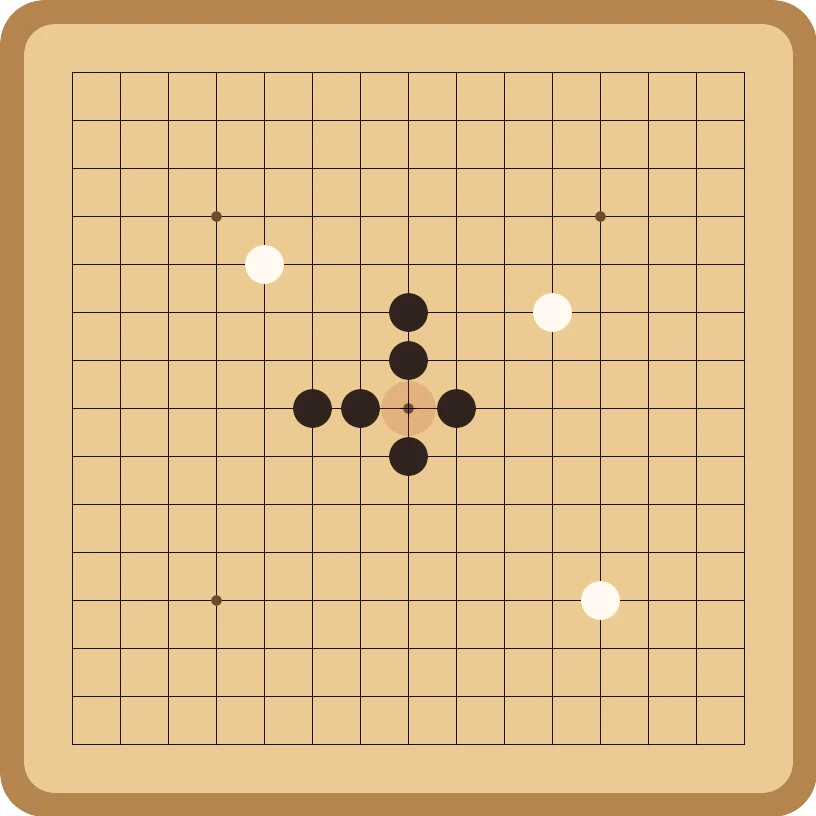
Confirm that two different blocks are required
When one opposing move connects two lines, mark the point where each line could next complete five or make a forcing advance. If one defensive stone can stop both lines, or if either line is closed at both ends, the position is not a true double threat that requires two replies.
Include every stone and the edge of the board in your reading. A three near the edge may have only one open end, while two crossing lines may share the same defensive point. Identify the actual threat points before naming the pattern; appearances alone can be misleading.
Find the shared intersection before it is occupied
A real double threat often grows from stones that do not yet touch. Two groups develop toward the same empty intersection. Once the attacker takes that point, the move may create a forcing four and an open three, two open threes, or two separate points that can complete five.
The best time to defend is while that shared intersection is still empty. Taking it can dismantle both plans with one move. If the same move also connects your own stones, a passive block becomes a fight for the initiative. After every opposing move, scan for empty points shared by the new stone and older groups.
If the threat lands, rank replies by force
First, check whether you can complete five immediately; if you can, the game is over. Next, look for a forcing four or another move your opponent must answer at once. Then ask whether one stone can cover both threat points. If none of those options exists, blocking one line usually delays the loss by only one move.
A counterattack matters only if it is forcing. An ordinary open three does not seize the initiative when your opponent can ignore it and complete five elsewhere. Do not compare which line looks more impressive. Compare which player's next move cannot be ignored.
Two positions worth recognizing
False alarm: one stone stops both lines
Black connects a horizontal and a diagonal line, and both appear to contain three stones. Their only useful ends, however, meet at the same intersection. White can occupy that point and stop both lines, so the position does not require two defensive moves.
A true four-three fixes the reply order
Black creates a forcing four and an open three with one move. White must first block the point that would complete five. Black uses that tempo to advance the open three into an open four, leaving two winning points that White cannot cover at once.
Check these three points before you play
- Mark the exact threat points first. A double threat is genuine only when it requires two different defensive points.
- Check whether you can complete five immediately. Winning now takes priority over every defensive move or counterattack.
- An ordinary extension is not a forcing counterattack. Only an immediate five or a forcing four your opponent cannot ignore can change the move order.
Common Gomoku Questions
Does a double three always mean the game is won?
No. Check whether both threes have enough open ends, whether they require different defensive points, and whether your opponent can complete five or play a forcing four first. Double threes are legal here, but a legal pattern is not automatically a forced win.
Why is an open four usually impossible to defend?
An open four has two endpoints where the next stone would complete five. The defender can occupy only one intersection per turn, so the attacker normally wins at the other endpoint. The main exception is when the defender can complete five first.
Where should I block a developing double threat?
Do not focus only on the latest stone. Find the empty intersection both groups depend on. Taking that shared point often dismantles both future lines at once. If the groups do not share a point, answer the route that creates the most forcing threat first.
How can I spot double threats earlier?
Replay a lost game and stop two moves before your first forced defense. Mark the open ends of every opposing pair or three, then circle each empty intersection targeted by two groups. Repeating this exercise trains you to notice shared points before the lines look long.
