
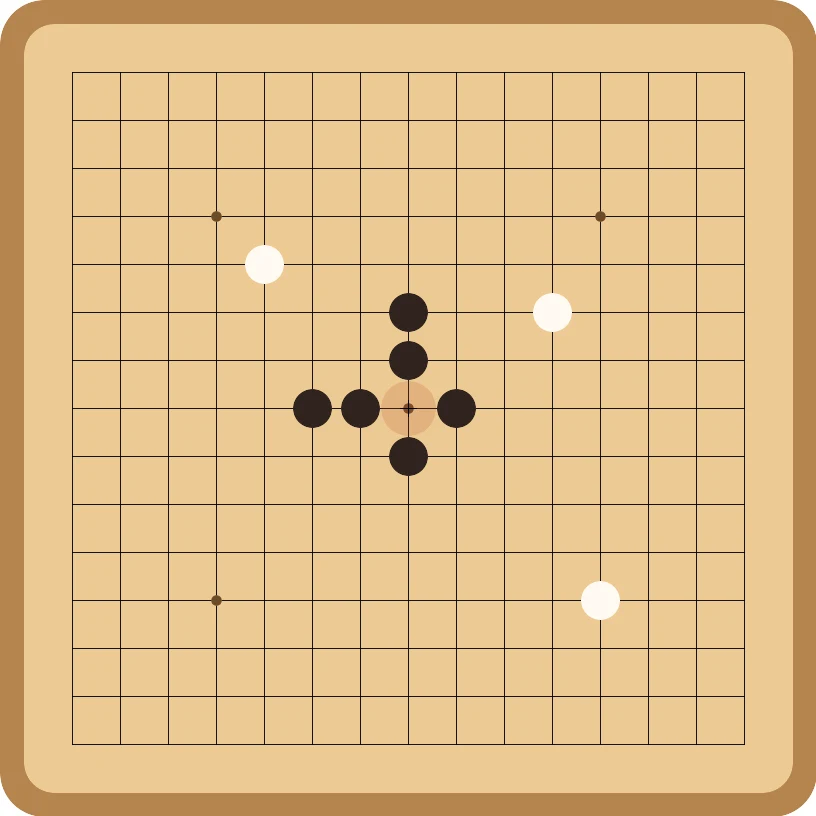
| Urgency | Shape | What this move does |
|---|---|---|
| Already won | Open four; four-three | One block is not enough. After the four is answered, the three still becomes an open four |
| Must block | Forcing four, jump forcing four | Only one square makes five. Leave it and the next stone wins |
| Should answer | Straight open three, jump open three; a killing square | Leave it and it becomes an open four, or the next stone is a four-three. A forcing four of your own can go first |
| Can wait | Sleeping three, open two | One more stone does not make an open four. There is usually time to look elsewhere |
| VCF | Forcing four after forcing four, until a four-three | Each reply can only fill the winning square. The sequence wins |
How to read these diagrams
Each board is a crop. Files run D to I, ranks are numbers. Black and white are stones already on the board. A thin ring marks the stone just played. Teal dots are winning squares, forced replies, or the empty killing square where the next stone makes a four-three.
Mark both ends before you count the middle. Two empty ends and no gap make a live shape. One blocked end usually still leaves time. This site is freestyle Gomoku: no Renju bans, and a line of six or more still wins.
Urgency: a forcing four outranks an open three, and a four-three is already won
A forcing move is one the opponent must answer to stop five. An open four wins at both ends, so it is already decided. A four-three is decided too: the opponent must take the four’s winning square, and you spend the next turn turning the three into an open four.
A forcing four is an absolute claim on the turn. If the opponent has an open three, you may still play your forcing four first and leave that three for later. A killing square is the empty point whose next stone is a four-three. It sits with the open threes: usually answer it, unless you have a forcing four of your own.
Fours: open four, forcing four, jump forcing four
A four is more urgent than a three, because the next stone can make five. Count the winning squares: two means an open four, one means a forcing four. A one-point gap with one side already blocked is often a jump forcing four, and it still has only one winning square. Block that square. There is no second choice.
Threes: straight open three, jump open three, a block that stands off, sleeping three
An open three is a three that can become an open four on the next move. A straight one has two defence squares. A jump one has three. Do not only block the gap in the middle of a jump three: a square off to the side is sometimes stricter. A block can also stand away from the black stones and still stop an open four. A sleeping three already has one dead end, so one move cannot make it live.
Twos: straight, jump, and long jump
A two that can become an open three with one more stone is an open two. It does not take the turn yet. Straight, jump, and long jump differ only by the size of the gap. These three diagrams are all on a rank. The same shapes on a diagonal are in the next section. Finish the open threes and forcing fours before you grow these twos.
Diagonals: the same shapes, on a line the board does not draw
Ranks and files are drawn on the board. Diagonals are not. A jump open three and a long-jump open two are easiest to miss on a diagonal. The definition does not change: look at whether both ends are open, and whether the next stone can make a four.
Combinations: four-three, double three, double four
A single forcing four or open three, answered correctly, does not win. To win, one intersection has to make two forcing threats at once. A four-three is a forcing four plus an open three, and it is already won. A double three and a double four are both legal here. In Renju those moves are forbidden for Black, so do not bring that ruling onto this board.
VCF: forcing fours until a four-three
A VCF is one forcing four after another until a four-three appears. Each of the opponent’s replies can only fill the current winning square, so there is no spare turn to break the other line you have already built. The three diagrams below are three moves of one game. Only the last move is the four-three.
Two positions worth recognizing
A jump open three has three defence squares, and the block need not touch
On the jump-open-three diagram the defence squares are D8, G8, and I8. Do not only block the gap on G8. On the standing-off diagram White is on I8, not against E8 and F8, and Black still cannot make an open four by playing G8. A straight open three is usually blocked on D8 or H8. A block that does not touch can stop it too.
A forcing four, another forcing four, then the four-three
The VCF starts with F8, and White can only take F5. The next diagram plays H7, and White can only take I7. Only H8 is both a forcing four and an open three: the win is I8, and the open three’s ends are H6 and H10. White had no spare turn, on the first two moves, to break that line.
Check these three points before you play
- A forcing four outranks an open three. When the opponent makes an open three, look for a forcing four of your own first. If you have one, play it, and leave that three for later.
- Do not only block the gap in a jump open three. Of the three defence squares, one off to the side sometimes cuts off the later four-three. A diagonal jump open three has three defence squares too.
- A double three and a double four are legal here. Do not judge Black on this board with Renju forbidden-move rules.
Common Gomoku Questions
Do you always have to block a straight or jump open three?
Usually yes. Leave it and the next stone can make an open four, and then you cannot cover both winning squares. The exception is making five yourself, or playing a forcing four the opponent must answer first. A jump open three has three defence squares. Do not only block the gap.
What is a block that stands off the stones?
It does not sit against the three, and it still stops the next stone from making an open four. On the jump-three diagram, White on the far square I8, rather than against E8 and F8, means Black’s stone in the gap can only make a forcing four. A straight open three can be stopped the same way. Not every open three has to be sealed by a stone touching it.
How is a killing square different from a four-three?
A killing square is the empty point where the next stone makes a four-three. The stone is not there yet. A four-three is that stone already played: one move is a forcing four and an open three at once, and the game is decided. When you see the killing square, usually take it, unless you have a forcing four of your own.
Why can’t a VCF be stopped?
Because a forcing four claims the turn, and each reply can only fill the current winning square. The diagrams play F8 first, so White can only take F5; then H7, so White can only take I7; then H8 is already a four-three, and I8 plus the two ends of the open three cannot be covered together. The sequence uses threes that were built earlier. It is not a last-second count to five.
Do you also block an open three on a diagonal?
Yes. A diagonal straight open three and a diagonal jump open three have the same urgency as the ones on a rank. Only the direction changes, onto a line the board does not draw. The three defence squares of the diagonal jump open three are D9, G6, and I4. Do not only block the gap. A diagonal long-jump open two is still only an open two, so this move does not have to be answered.
