
Count directions, not just stones
The area near the center is usually more flexible, but not because the center carries a special value. Stones there have room to extend horizontally, vertically, and along both diagonals. Near an edge, the boundary closes some routes early and gives each stone fewer useful lines to join.
For every candidate, identify the friendly stones it could eventually connect. A point that supports both a horizontal and a diagonal line may offer more potential than extending one row into a closed three, even if it currently creates only two loose pairs.
Ask what one defensive move can stop
Two or three consecutive stones are easy to recognize, but they may concentrate your entire plan on one endpoint. If your opponent can occupy that point and remove every useful continuation, the shape offers less choice than its length suggests.
A stronger move makes the defender choose. Blocking the horizontal route leaves the diagonal connection; taking one shared intersection leaves another direction open. The goal is not always to threaten an immediate win. It is to prevent one defensive stone from dismantling every plan at once.
Check shared intersections on every turn
Do not base your opening defense only on the opponent's latest stone. Look for an empty intersection that two separate groups of opposing stones both need. If taking that point would activate two directions at once, it may be more urgent than the nearest visible pair.
The best defensive move often does two jobs: it breaks the opponent's connection while beginning one of your own. If two candidates disrupt the same plan, prefer the one that still leaves your stones more than one useful direction.
Two positions worth recognizing
A loose move can preserve two paths
Black has two adjacent stones on a horizontal line. Instead of extending the row, Black places the next stone diagonally above it, allowing the middle stone to support both lines. If White blocks the horizontal endpoint, the diagonal still has a shared intersection to watch.
One defensive move can also build initiative
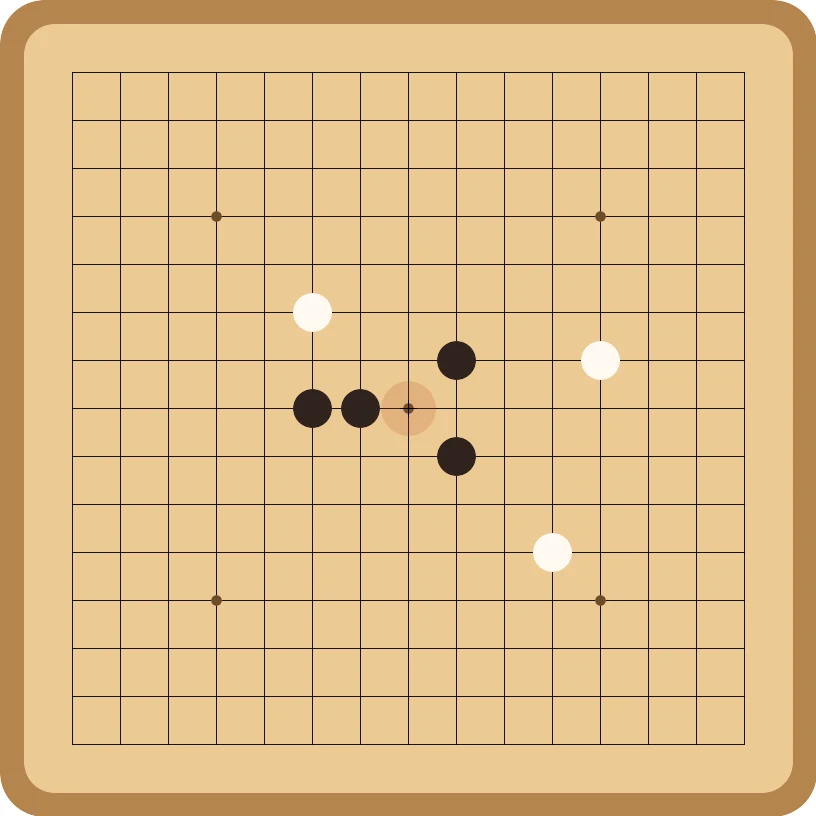
White sees two groups of black stones developing toward the same central intersection. By taking that point first, White breaks Black's future two-way connection and forms an open pair with a nearby white stone.
Check these three points before you play
- Every opening principle gives way to an immediate win, a forcing four, or a threat that must be answered now.
- A symmetrical shape does not have the same value for both players. Black's extra move changes the initiative.
- Do not chase two directions mechanically. If one opposing move can block both, the position still offers very few real options.
Common Gomoku Questions
Does the first stone have to go in the exact center?
No. The center and nearby intersections all preserve several directions. The exact first move usually matters less than whether the next few stones support one another. Never chase the center while ignoring a forcing threat your opponent has already created.
How can I tell whether a move preserves real options?
Trace the horizontal, vertical, and two diagonal lines the stone could join. Then ask whether your opponent can disrupt every plan with one reply. You preserve real options only when at least two useful directions require different defensive points.
Should I attack or defend in the opening?
Answer forcing threats first, then look for shared intersections that help both attack and defense. Defending every loose stone gives away the initiative, but ignoring your opponent can allow one connecting move to create two threats at once.
How should I practice the first ten moves against the AI?
Choose Medium difficulty. Before each move, name two candidates, the directions each one preserves, and your opponent's strongest reply. After ten moves, open Replay and ignore the final result. Find the first move that reduced your position to a single useful plan.
