
| Gomoku (this site) | Go | |
|---|---|---|
| Goal | Five or more in a row, first | Score at the end, not five in a row |
| Board | 15×15 | Formal play is usually 19×19; also 13×13 and 9×9 |
| Placement | Intersections | Intersections |
| Capture | None. A stone stays where it was played | Removed only at zero orthogonal liberties. Diagonals do not count |
| End | Five in a row stops the game | After consecutive passes, territory or stone scoring |
| Length | A few minutes to about fifteen minutes | Often tens of minutes to more than an hour |
| What forces a reply | Open threes, forcing fours, double threats | Atari, capturing races, the endgame |
| Who starts | Black first, no komi | Black first; komi follows the ruleset, not one fixed number |
Different goals: five in a row does not finish Go
Each turn in Gomoku places one stone on an intersection. It stays there. It does not move, and it does not capture. The first player to make five in a row, column, or diagonal wins. On this site five or more wins, so an overline counts. A game often lasts a few minutes to about fifteen minutes.
Go does not race to five. Five stones in a line do not end a Go game. Play continues until both sides have passed in a row, and any count belongs to that ending. Being able to play Gomoku does not mean you can play Go.
The diagram is exactly five black stones, on D8, E8, F8, G8, and H8. H8 is the fifth stone, marked with a ring. On this site Black wins and the game stops. In Go those five stay on the board and the game continues. Life and death are still open, and the eventual count depends on which scoring system is in use.
Liberties and capture, which Gomoku does not have
In Go, each orthogonally adjacent empty intersection is one liberty, for a single stone or for a connected group. Diagonals do not count. A connected same-color group shares liberties. At zero liberties the group is captured and removed. One liberty left is atari: the opponent plays that point and captures.
Gomoku has no liberties and no capture. A surrounded stone stays until someone makes five or the board fills. Do not wait for a stone to be taken off before you block an open three.
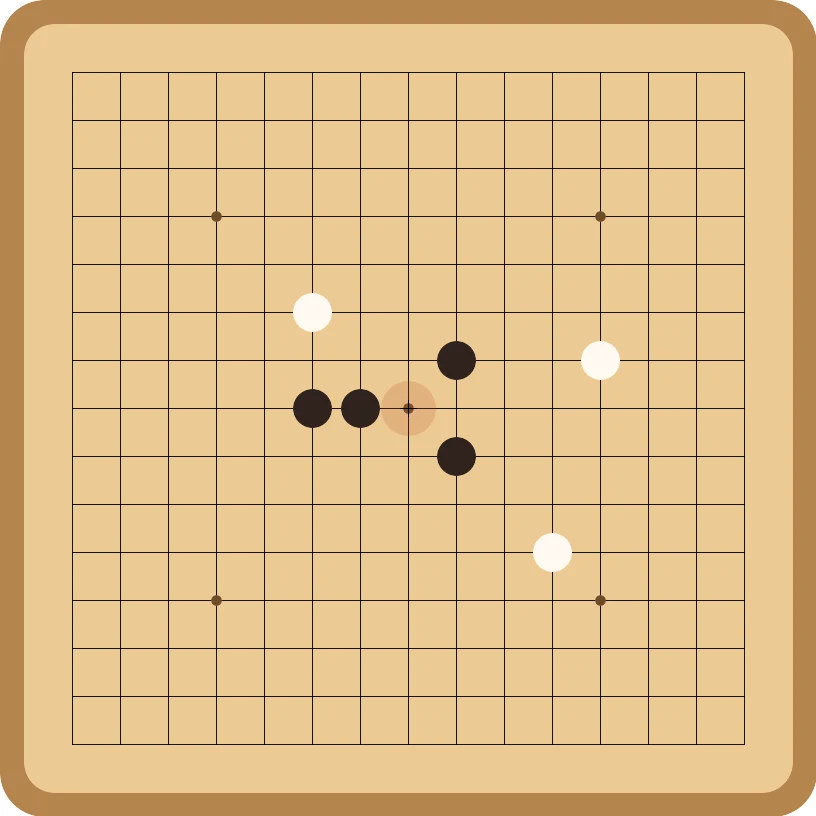
The next diagram is legal in Gomoku. Black is on H8. White is on H9, G8, I8, and H7, so every orthogonal neighbor is filled. The diagonal empties G9, I9, G7, and I7 are not liberties of H8. All five stones stay, nobody has five, and the game continues. In Go, when White played the stone that filled the last liberty, the black stone was already captured and should not still be on the board.
Ending and komi: "more territory" is not all of Go
Go does not end the same way under every ruleset. Chinese competition rules give three ways: both sides play consecutive passes, one side resigns, or both confirm that play is finished. Counting starts only after that confirmation. Under Japanese rules, after both pass, the players still agree which stones are dead, and a dispute can resume play. Resignation also ends the game. Gomoku has no pass. Five ends it. Which counting system is used is not one worldwide table.
Territory scoring works like this. At the end, a color's dead stones, and the stones of that same color captured during the game, are filled into that color's empty territory. You then count the empty points that remain. Living stones on the board are not added. Japanese rules use this. Stone scoring removes the dead stones and does not fill them back into the empty points. You count your living stones plus the points those living stones surround. Empty points between the two living groups are split in half. Chinese competition rules use this. The two methods often pick the same winner in ordinary games, but whether dead stones fill territory is not the same operation. "More territory" only approximates Japanese territory scoring. It does not describe all Go.
Black moves first, and that is an advantage. Komi is the amount taken off Black at the end, to offset the first move and to split many games that would otherwise be draws. The number belongs to the ruleset. The Nihon Ki-in currently publishes that Black gives 6.5 points, with territory scoring. The Chinese Weiqi Association's published competition rules say Black gives 3.75 stones, with stone scoring. Other events may set another number. Do not treat either number as the komi of all Go.
This site has no komi and does not count after passes. Five ends the game. Allis, in 1993, proved that 15×15 freestyle Gomoku is a first-player win, so this ruleset does not use komi to balance it. That is a Gomoku result, not a Go result.
An open three is not a living group, and a forcing four is not atari
An open three and a living group only sound related. An open three is three stones of one color, both ends still able to extend. One more stone makes an open four. Under Chinese competition rules, a living group is one both players confirm at the end cannot be captured. A group that can be captured is dead. Two eyes are a common way to live, not the definition itself. Gomoku has no eyes and does not survive by making life.
A forcing four and atari both demand the next move, and they stop different things. A forcing four means one more stone makes five. If it is not blocked, the game ends. The double threat in the table is one move that makes two places that can become five. Blocking one leaves the other. Atari means one liberty is left. If that point is not played, the group is captured, and the game usually continues. A capturing race is whose liberties run out first. The endgame is how many points a move is worth near the end. Taking the big point first, the way Go does, misses a Gomoku open three or forcing four that already had to be answered.
The bans are not one list. Renju bans restrain Black's double three, double four, and overline. Go does not have those bans. A Chinese forbidden point is a move that would leave the stone with no liberties and would not capture the opponent. That move is illegal. Japanese rules also forbid that suicide. Recapture is a separate question. Japanese ko says you cannot immediately recapture on the point where you just captured. Play elsewhere first. Article 6 of the Chinese competition rules is wider, a ban on repeating a whole-board position: after your move, the opponent must not face a position that has already occurred. Gomoku has no liberties and no capture, so it has neither ko nor that superko. This site allows any empty intersection. Renju bans are not losses here.
Can the boards be swapped, and why Renju is a third game
This site is 15 lines, 15×15 intersections. Formal Go is usually 19 lines. Boards of 13 and 9 lines are smaller Go practice boards. The rules on them are still Go, not Gomoku. Both games play on intersections, not inside the squares.
A 19-line board can host Gomoku by using only the central 15 lines. The outer lines stay out of the game. A 15-line board cannot hold standard 19-line Go. This site has only the 15×15 and does not draw on a 19-line board.
Renju is a third game. It is still five in a row, not territory. Black has bans, and the opening must be one of 26 named openings. That is not this site's freestyle, and it is not Go. The bans, rule 9.3, and the opening procedure are on the rulesets page.
This site only plays Gomoku
This board is freestyle Gomoku. Black plays first. Five or more wins, including an overline. There are no Renju bans, no capture, no komi, and no endgame count. It is not 19-line Go. To practice connecting five, and to read an open three or a forcing four, play on the board beside this page.
If someone calls this game Go, put the table above in front of them. The stones match. The way the game is won does not. Five in a row, a group with no liberties, territory scoring, and stone scoring do not stand in for one another.
Two positions worth recognizing
Five in a row ends Gomoku
In the diagram in the section on five in a row, D8, E8, F8, G8, and H8 are black, and H8 is the fifth stone, marked with a ring. On this site the game stops at once and Black wins. In Go those five would stay, and the game would continue until both sides played consecutive passes or someone resigned, and only then would you score by territory or by stones.
A stone boxed on four sides stays in Gomoku
In the diagram in the section on capture, the black stone on H8 has white stones on H9, G8, I8, and H7. In Gomoku all five stones stay, nobody has five, and the game continues. In Go, when White played the stone that filled the last liberty, that black stone was already captured and should not still be on the board. The diagonal empties G9, I9, G7, and I7 are not liberties. Do not wait for the stone to disappear before you block an open three.
Check these three points before you play
- Sharing the intersections does not make them one game. Ask whether this game is five in a row, or a count that starts only after consecutive passes.
- Gomoku does not capture. Go removes a group only when it has no liberties, and diagonal empties are not liberties.
- "More territory" only approximates Japanese territory scoring. Chinese competition rules use stone scoring. Komi follows the ruleset. It is not one fixed number.
- An open three is not a living group, and a forcing four is not atari. Renju is not Go. The bans and the 26 openings are on the rulesets page.
Common Gomoku Questions
Is Gomoku a simplified version of Go?
No. Both use black and white stones on intersections, but the win is not what remains after you delete a few clauses from one shared ruleset. Gomoku races to five. Stones are not captured, and empty points are not counted. Go ends when both sides play consecutive passes, one side resigns, or both confirm that play is finished. The count, by territory or by stones, starts only after that confirmation, and a group with no liberties is removed. Knowing one does not give you the other.
Why do the names get mixed up?
The equipment is almost the same: one bowl of stones, the same kind of wooden board, and stones on the crossings. People swap the names in ordinary speech. Before the first stone, say whether you are playing five in a row, Renju, or Go under territory scoring or stone scoring. Do not discover in the middle of the game that the rules never matched.
Can I play Go on this site?
No. This board only plays freestyle Gomoku. There are no liberties, no captures, and no territory score or stone score after passes. It is not a 19-line board. This page separates the two games. It is not a lesson in how to play Go.
What do Go players miss when they try Gomoku?
An open three or a forcing four that already had to be answered, and the fact that the stone in front of them will not be captured. Go can take the big point first, and atari does not have to end the game. Leave an open three in Gomoku and the next stone is an open four, with two places that make five and no way to block both. Surrounding the opponent does not take the stone off.
What is komi?
There is no number shared by every ruleset of Go. The Nihon Ki-in currently publishes that Black gives 6.5 points, with territory scoring. The Chinese Weiqi Association's published competition rules say Black gives 3.75 stones, with stone scoring. Other events may set another number. Gomoku on this site has no komi. Five ends the game.
Can a 19-line board play Gomoku, and is Renju the same thing?
A 19-line board can host Gomoku if you use only the central 15 lines and leave the outer lines out of the game. A 15-line board cannot hold standard 19-line Go. Renju is another five-in-a-row game, not a territory game: Black has bans, and the opening must be one of 26 named openings. That is not the ban-free freestyle ruleset on this site. The bans, rule 9.3, and the opening procedure are on the rulesets page.
