
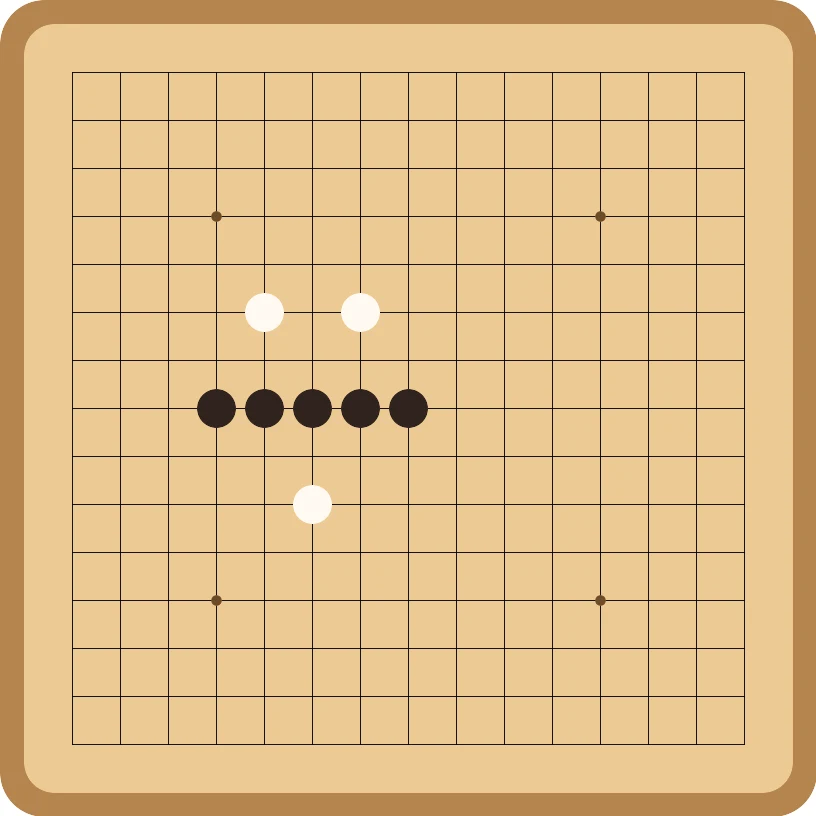
Place stones on intersections and connect five
Black moves first. Players then alternate placing one stone on any empty intersection. Stones do not move, jump, or capture after they are placed. The game ends as soon as either player forms an unbroken line of at least five stones horizontally, vertically, or along either diagonal.
“Unbroken” is the key word. A gap in the middle breaks the line, as does an opposing stone. If two lines cross at one stone, count each direction separately. You cannot turn a corner and combine stones from two directions to make five.
Five or more wins
Double threes and double fours are legal, and an overline of six or more stones wins. White follows the same five-or-more rule.
Moving first still gives Black the initiative. For a fair series, alternate colors after each game. In an online room, the host can also switch sides before the first stone is played. Either approach is clearer than introducing forbidden moves halfway through a game.
Agree on takebacks before the game
Undo, Hint, and Replay are practice tools in AI mode; they do not make a game official or rated. In local two-player mode, decide beforehand whether takebacks are allowed and whether an accidental tap stands. In online play, the position confirmed and synchronized by the room is the official game state.
Always place stones where the grid lines intersect, not inside the squares. On a small phone screen, check the target intersection carefully before tapping. If the board display behaves unexpectedly, start a new game rather than trying to settle the result from a screenshot, then report the problem to the site.
Two positions worth recognizing
A gap breaks the line
Black occupies several points on one horizontal line, but the fourth point is empty. The stones form two separate groups—three on one side and two on the other—not an unbroken five. The game continues.
One stone can complete two winning lines
A stone at the center completes both a horizontal five and a diagonal five. Black wins immediately. There is no need to choose one line or continue playing to prove the other.
Check these three points before you play
- Place stones at the intersections of the grid lines, not in the centers of the squares.
- Overlines win here, and double threes and double fours are legal. Do not add Renju restrictions after the game has started.
- Before local play, agree on accidental taps and takebacks. In online play, follow the position confirmed by the room.
Common Gomoku Questions
Why did six stones in a row win immediately?
Five consecutive stones is the minimum winning line, so an overline of six or more also wins. Some Renju rules treat an overline by Black differently, but those restrictions do not apply here.
Can five in a row run along either diagonal?
Yes. Five consecutive stones of the same color win from upper left to lower right or from upper right to lower left, just as they do horizontally or vertically.
Does Black lose for playing a double three or double four?
No. double threes and double fours are legal. The winner is simply the first player to form an unbroken line of five or more stones.
Do local and online games use different rules?
No. In both modes, Black moves first. Only the controls differ: local players share one device, while an online room synchronizes the moves and game state between two devices.
