
| Ruleset | Board | How you win | Black’s limits | Opening | Playable here? |
|---|---|---|---|---|---|
| Freestyle on this site | 15×15 | Five or more | None | Black opens | Yes |
| Exact five on this site | 15×15 | Exactly five; an overline does not win | No bans | Black opens | Yes |
| RIF competitive Gomoku | 15×15 | Exactly five | No bans | Swap2 | No |
| Renju | 15×15 | Exactly five; Black overlines banned | Double three, double four, overline | 26 named openings | No |
| Omok | 15×15 or 19×19 | Five; an overline often does not win | Depends on the set | Depends on the set | No |
| Caro | Often 15×15 | A five blocked at both ends does not win | No Renju bans | Depends on the event | No |
Freestyle and exact five are playable on this board
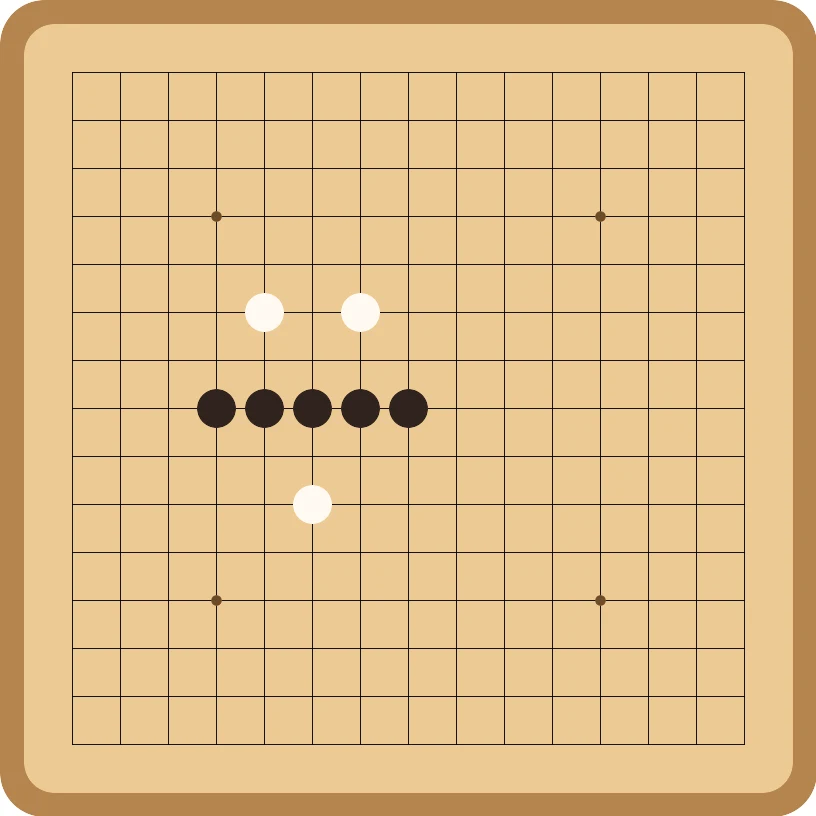
Black moves first. Players alternate on empty intersections. Under the default, freestyle, five or more of the same colour in a row, column, or diagonal ends the game at once, and an overline of six or more still wins. If Settings or the room picked exact five, only an exact five wins; six or more on that line do not. Double threes and double fours are legal.
Freestyle is the casual set most people mean by Gomoku, and it is the default. Exact five scores an overline the same way RIF tournament Gomoku does, but the opening is still Black first, with no Swap2. The same choice applies against the AI, on a shared screen, and in a room. It is not a rated event. Allis showed in 1993 that 15×15 freestyle is a first-player win; if you care about colour, swap sides each game or before the first stone in a room.
RIF tournament Gomoku: an exact five, opened with Swap2
Tournament Gomoku is not this board. RIF scores an exact five: six or more on that line do not win. Colour is settled with Swap2, not by Black simply moving first.
The first player lays three stones in order, black, white, black, before either player owns a colour. The second player chooses Black, chooses White, or adds two stones and hands the choice back. Those two stones are one white and one black. After the hand-back, the first player must choose a colour and cannot add another stone. Whoever is White then plays. Rooms here do not run this opening, and an overline is not a loss.
Renju restrains Black with bans
Renju limits Black’s double threes, double fours, and overlines, to offset the first-move advantage. A forbidden Black move loses at once. The stone stays down. If that same move already makes an exact five, Black wins even when the shape also looks like a double three or a double four. White has none of these limits, and a White overline wins. This board does not check bans. Double threes and double fours are legal. Under freestyle an overline wins; under exact five it does not.
Two threes on the board are not automatically a loss. In Renju a “three” is a three that becomes an open four with one more stone, without that stone already making five. A sleeping three, which only becomes a forcing four, does not count. Black enters the double-three ban by making two or more of these threes in one move. Rule 9.3 of the RIF text allows the move if either test holds. First: at most one of those threes can still become an open four, and that square does not also make an overline or a double four. Second: at most one can still become an open four, and that square does not also make another forbidden double three. Play the move in your head, then try each test. If the open four creates a new double three, test that one the same way. A four is four stones that become five with one more stone. Both an open four and a forcing four count. Two or more of them in one move is a double four, and 9.3 does not excuse it. An overline is six or more, and it has no exception either. In the first diagram below, Black has just played H8 and both lines can become open fours, so the move loses. In the second, only the rank can. On the file, H6 is already five and H10 is a double four, so the first test of 9.3 keeps the move.
Renju openings are the 26 named patterns, not Swap2. The first three moves must be one of them. How many fifth-move offers Black shows, and when the colours swap, is the next section. N is not fixed at 2. Do not switch to Renju during a game, and do not treat a forbidden square as a win on this board.
Fifth-move offers: when the colours swap
In a Renju opening, N is not one fixed number. N is how many fifth-move candidates Black must offer. A swap trades colours. It does not pick the stones back up. The four procedures below say who may swap after which move, and when N is declared. The AI, two-player, and rooms on this site follow none of them. Swap2, above, is the opening for RIF tournament Gomoku, not for Renju.
The two-offer rule is the written opening in the International Rules of Renju, adopted by the RIF general assembly on 2 May 1996 and corrected on 3 May 1998, article 12. Tentative Black plays all three of the first moves, and they must be one of the 26 openings. Tentative White then decides who will be Black and who will be White. That is the only swap. The player who is now White plays the fourth move on any empty point. Black must offer two fifth moves that are not symmetrical, White keeps one, and White plays the sixth move anywhere. The special opening ends with the fifth move. Passing is not allowed on the first three moves. N is fixed at 2. Article 12 still says this.
Under the Yamaguchi rule, N is declared with the opening, and the RenjuNet text sets no upper limit. The first player lays one of the 26 and announces how many fifth moves this game will offer. The opponent may swap once. White then plays the fourth move anywhere. Black lays that many non-symmetrical fifth moves. White keeps one and plays the sixth. The only swap comes before the fourth move. Individual world championships from 2009 to 2015, and team world championships from 2010 to 2016, used this rule.
Soosyrv-8 moves the announcement of N to the fourth move, and N must be from 1 to 8. The first player lays one of the 26, and the opponent may swap. White plays the fourth move anywhere and declares which number from 1 to 8 will be offered. The opponent may swap again. Black lays that many non-symmetrical fifth moves. White keeps one and plays the sixth. There are at most two swaps: one after the first three moves, and one after the fourth move and the declaration of N. The individual world championships of 2017, 2019, and 2023, and the team world championship of 2018, used this rule.
Taraguchi-10 is the opening of the current individual and team world championships. The RenjuNet text is as follows. Black 1 must be the centre, and the opponent may swap. White 2 must be inside the central 3×3, and the opponent may swap. Black 3 must be inside the central 5×5 and still one of the 26, and the opponent may swap. White 4 must be inside the central 7×7. After the fourth move there are two branches. In the first, the opponent may swap, Black 5 is inside the central 9×9, the opponent may swap again, and White 6 is anywhere. That branch offers no candidates. Swaps can come after moves 1, 2, 3, 4, and 5, five times at most. In the second, Black offers 10 non-symmetrical fifth moves anywhere, White keeps one, and White 6 is anywhere. N is 10, and there is no swap after the choice. The team world championship of 2024 and the individual world championship of 2025 used this rule. It does not rewrite article 12. That article is still the two-offer rule.
The 26 named openings
A named opening is only the first three moves. Black 1 is the centre. White 2 is next to the centre inside the central 3×3: a direct opening is orthogonal, an indirect opening is diagonal. Black 3 is inside the central 5×5. After rotations and reflections, there are 13 direct and 13 indirect openings. If Black 1 and Black 3 lie on the same line or diagonal with exactly one point between them, the name uses “star”. Otherwise it uses “moon”. Placements outside these 26 are not in the catalogue.
Coordinates on this board run A to O from left to right, including I, and 1 to 15 from bottom to top. The two diagrams in this section and the list in the next one are the same catalogue. Black 1 is H8. Direct White 2 is H9. Indirect White 2 is I9. The characters on the squares are the names of Black 3. Files F and G are blank on the direct diagram because they are the mirror of the right-hand side and are not counted again. A rotation is the same opening. This site does not require these openings.
The 26, one by one
D1 Kansei: Black 3 is H10. White on H9 sits between H8 and H10.
D2 Keigetsu: Black 3 is I10.
D3 Sosei: Black 3 is J10. H8 and J10 share a diagonal with empty I9 between them.
D4 Kagetsu: Black 3 is I9.
D5 Zangetsu: Black 3 is J9.
D6 Ugetsu: Black 3 is I8.
D7 Kinsei: Black 3 is J8. Empty I8 sits between H8 and J8.
D8 Shogetsu: Black 3 is H7.
D9 Kyugetsu: Black 3 is I7.
D10 Shingetsu: Black 3 is J7.
D11 Zuisei: Black 3 is H6. Empty H7 sits between H8 and H6.
D12 Sangetsu: Black 3 is I6.
D13 Yusei: Black 3 is J6. H8 and J6 share a diagonal with empty I7 between them.
For the indirect openings, White 2 moves to I9. Black 1 is still H8.
I1 Chosei: Black 3 is J10. White on I9 sits between H8 and J10.
I2 Kyogetsu: Black 3 is J9.
I3 Kosei: Black 3 is J8. Empty I8 sits between H8 and J8.
I4 Suigetsu: Black 3 is J7.
I5 Ryusei: Black 3 is J6. H8 and J6 share a diagonal with empty I7 between them.
I6 Ungetsu: Black 3 is I8.
I7 Hogetsu: Black 3 is I7.
I8 Rangetsu: Black 3 is I6.
I9 Gingetsu: Black 3 is H7.
I10 Meisei: Black 3 is H6. Empty H7 sits between H8 and H6.
I11 Shagetsu: Black 3 is G7.
I12 Meigetsu: Black 3 is G6.
I13 Suisei: Black 3 is F6. H8 and F6 share a diagonal with empty G7 between them.
How the Omok sets differ, and Caro
Omok is not one rule shared by every association. The three descriptions below can be checked in public sources. Do not collapse them into “19 lines, double three banned”. This site plays none of them.
The everyday Korean rule bans a double three for both colours. A double four may be played. An overline may be played and does not win. Renju is different: only Black is limited, a White overline wins, Black’s double four is forbidden, and a double three is kept or lost under rule 9.3.
Korean O-muk in the ICGA literature is another write-up. It is not a quotation from the bylaws of the Korea Omok Association. It uses 19×19, an overline wins for neither colour, Black 1 is the centre, White 2 must be inside the central 5×5, and Black may not make a double three or a double four. White 2 has a wider box than the central 3×3 of a named Renju opening, and Black is limited by a double four as well as a double three.
Korean rule notes often split “Renju” from “opening Renju”. The first is 15×15 and limits only Black: double fours, overlines, and double threes that rule 9.3 does not keep. A White overline wins, and the opening procedure can be skipped. The second adds the RIF-style named opening on top of the same bans: the first three moves are one of the 26, tentative White chooses the colours, White plays the fourth move, and Black offers two non-symmetrical fifth moves. International Renju events put the bans and the opening in the same RIF rules. They do not use these two names.
Vietnamese Caro also says a five blocked at both ends does not win. This site does not: a blocked five still wins. Under freestyle an overline also wins; under exact five it does not. Agree the set before the first stone.
Two positions worth recognizing
One line of six, three different rulings
The overline diagram is six black stones from D8 to I8. Under freestyle the game ends and Black wins. Exact five on this site and RIF tournament Gomoku do not count the line, because it is not an exact five. In Renju, Black loses at once for playing it, and the stone is not taken back. A White overline wins in Renju. In Renju an exact five still wins: if Black makes only five, the move wins even when it looks like a double three or a double four.
Swap2’s three stones are not ordinary turns
The first three stones are black F9, white E8, and black G7, and neither player owns a colour yet. The second player may take Black, take White, or add one white and one black. The diagram adds white H9 and black I8. The first player must then choose a colour and cannot add another stone. White plays next. That is an opening colour choice, not the first three moves of freestyle.
Check these three points before you play
- This site has no bans. Under freestyle an overline wins; under exact five it does not. In Renju, Black loses at once for an overline, a double four, or a double three that rule 9.3 does not keep. A sleeping three is not a “three”. In Renju an exact five still wins. Do not switch to Renju during a game.
- RIF tournament Gomoku is an exact five plus Swap2. If the second player adds stones, they are one white and one black, and the first player must then choose a colour. Exact five here only changes how an overline is scored. The opening is still Black first, with no Swap2.
- Caro’s rule that a five blocked at both ends does not win does not apply here.
- The two-offer rule, Yamaguchi, Soosyrv-8, and Taraguchi-10 are not openings on this site. N changes with the procedure. It is not fixed at 2.
Common Gomoku Questions
Why do some people say an overline does not win?
Look at the six black stones from D8 to I8. Under freestyle Black wins with that move. Exact five on this site and RIF tournament Gomoku require an exact five, so the line does not win. In Renju, Black loses at once for playing it, while White’s own overline wins. Before the game, this page and the rules page are the source.
Does this site ban any move for Black?
No. Double threes, double fours, and overlines are legal. In Renju, Black loses at once for a double four, an overline, or a double three that rule 9.3 does not keep, and the stone is not taken back. A sleeping three does not count as that kind of three. A double three is kept if it meets either test: at most one three can become an open four without that square also making an overline or a double four, or at most one can become an open four without that square also making another forbidden double three. An exact five still wins. That set is not playable here.
Can I play Swap2 or Renju on this board?
Swap2 is available against the AI: pick it in Settings, place three stones (black, white, black), then the second player takes Black, takes White, or adds one white and one black so the first player must choose. After colours are set the game is freestyle, and White plays next. Two-player and rooms still open with Black and do not run Swap2. Renju bans are not checked.
What is N in a fifth-move offer, and when do the colours swap?
It depends on the procedure. In the two-offer rule N is 2, and the only swap is after the first three moves. Yamaguchi declares N with the opening, sets no cap, and swaps only once, before the fourth move. Soosyrv-8 uses N from 1 to 8, declared by White with the fourth move, and allows a swap after the first three moves and another after the fourth. In one branch of Taraguchi-10 there are no candidates, and a swap is allowed after each of moves 1 through 5. In the other branch a swap is allowed after moves 1, 2, and 3, then Black offers 10 fifth moves and there is no swap after the choice. This site plays none of these.
Is Omok the same game as Renju?
No. In the everyday Korean rule both colours are forbidden a double three, a double four is allowed, and an overline does not win. Korean O-muk in the ICGA literature is 19×19, White 2 must be inside the central 5×5, Black is forbidden a double three and a double four, and an overline wins for neither colour. What Korean notes call Renju is close to the RIF bans, and opening Renju adds the named opening. None of these is playable here.
What should friends agree before they play?
Agree whether you are using freestyle or exact five: Black opens, no bans; freestyle scores five or more, exact five does not score an overline. If someone is used to Renju, Omok, or Caro, settle it before the opening, not in the middlegame.
